


Article written by Guillaume JULLIAN of Mécanuméric Industrie et Benoît CANTIN of Metal-Interface
In demanding sectors, such as the aerospace industry, where the cost of aluminium alloys (such as 2024 or 7075) is constantly rising, raw material management is a key driver of profitability. For sheet metal workers and subcontractors, one question remains: which cutting technology should be prioritised? Whilst milling has long been the standard due to its precision, waterjet cutting technology is now establishing itself as a viable alternative, particularly thanks to its superior nesting capabilities.
We conducted a comparative study on a series of 642 actual aerospace sheet metal parts to quantify the material and efficiency gains between these two processes.
1. Technologies and Software Ecosystems
The choice of a machine is not limited to its mechanical components; it also depends on the software that controls the cutting and nesting strategies.
- Milling (e.g. Mecatype, Rhino, Mastercam, etc.): This is the realm of pure machining. Here, programming is complex. The operator must select the tools (milling cutters), set the rotational speeds and define the paths to prevent tearing or overheating.
Waterjet cutting (e.g. IGEMS, Alma, TopSolid, etc.): Unlike milling, the software manages most of the cutting strategy based on the material, thickness and desired finish quality. It is so straightforward that an operator can work independently in just three days.
2. Comparative analysis using a ‘nesting’ exercise involving the two technologies
For our test, we took a batch of 642 parts to be produced from a 1m x 2m sheet of aluminium.
The Milling Scenario (software used: MECATYPE)
In milling, the main constraint lies in the diameter of the tool.
- To cut out our parts, we needed to use two milling cutters (3mm and 6mm in diameter).
- Material consumption: 5 full sheets.
Constraints: Milling requires significant spacing between parts to ensure the sheet’s rigidity during machining and to allow the tool to pass through. Furthermore, it is often necessary to provide clamps or holding systems that ‘use up’ the surface of the raw material.
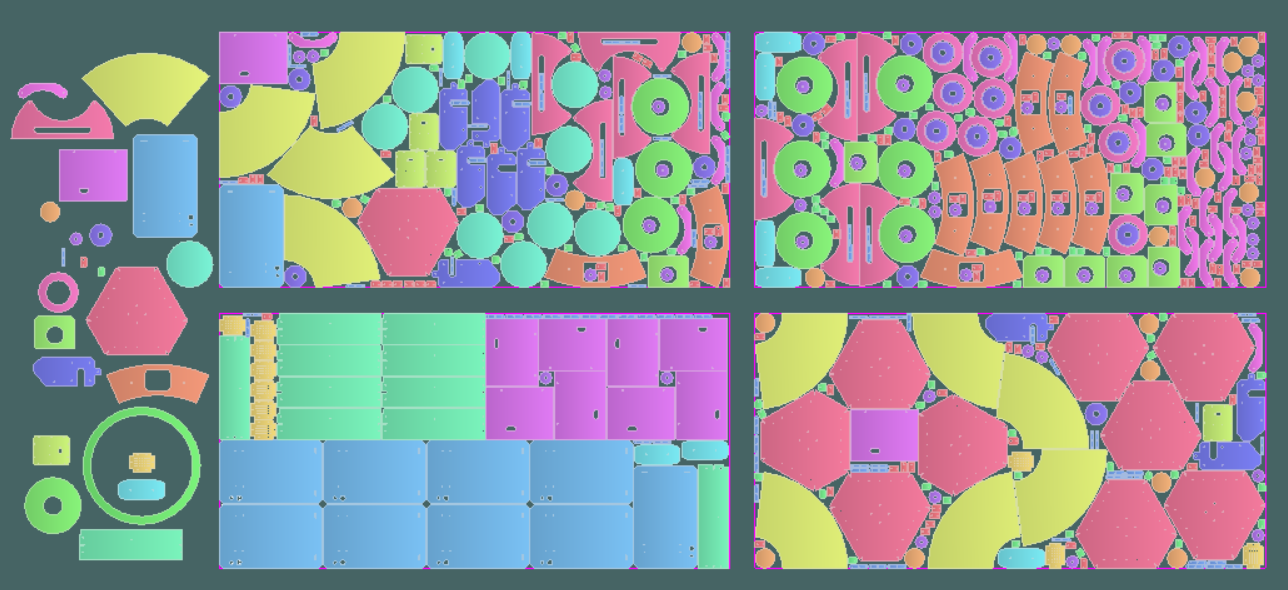
The Waterjet Scenario (using IGEMS software)By combining waterjet technology with the intelligence of the IGEMS software, the results are:
- Material consumption: just 4 sheets (for the same 642 parts).
- Performance: A material utilisation rate of 85%, meaning only 15% waste.
- The secret: ‘Joint Cutting’. Waterjet cutting allows for extremely fine cut lines (approximately 1 mm). It is therefore possible to use shared cutting, i.e. joining the parts together so that a single waterjet cutting pass can be used to cut two parts. This space saving allows for the saving of a whole sheet of metal, in this case on a medium-sized batch.
Copyright Mécanuméric Industrie
Visit the Mecanuméric website to discover their
Material savings: Switching to waterjet cutting saves 20% in raw materials (4 sheets compared to 5 with milling). In the aerospace industry, where aluminium is expensive per kilo, the machine pays for itself quickly through material savings alone.3. Other benefits of waterjet cutting
Beyond material savings, waterjet cutting offers technical benefits:
- No heat-affected zone (HAZ): This is a key selling point for the aerospace sector. Waterjet cutting is a cold cutting process. Unlike laser cutting or high-speed milling, which can alter the mechanical properties of the aluminium surface. Waterjet cutting preserves the structural integrity of the metal.
- Versatility and thickness: Where milling struggles with soft materials (engineering rubbers, foams) or very hard materials (composites, titanium), waterjet cutting cuts through everything. It can handle thicknesses ranging from 0.5 mm to over 200 mm using the same tool: a single cutting head.
- Simplified workflow: Stock management is simplified. There is no longer any need to manage hundreds of fragile and costly cutter types. The abrasive (sand) and water are the only consumables.
- No heat-affected zone (HAZ): This is a key selling point for the aerospace sector. Waterjet cutting is a cold cutting process. Unlike laser cutting or high-speed milling, which can alter the mechanical properties of the aluminium surface. Waterjet cutting preserves the structural integrity of the metal.
4. When is milling still essential?
Despite waterjet cutting’s dominance over milling, milling still has specific applications where it remains the preferred method:
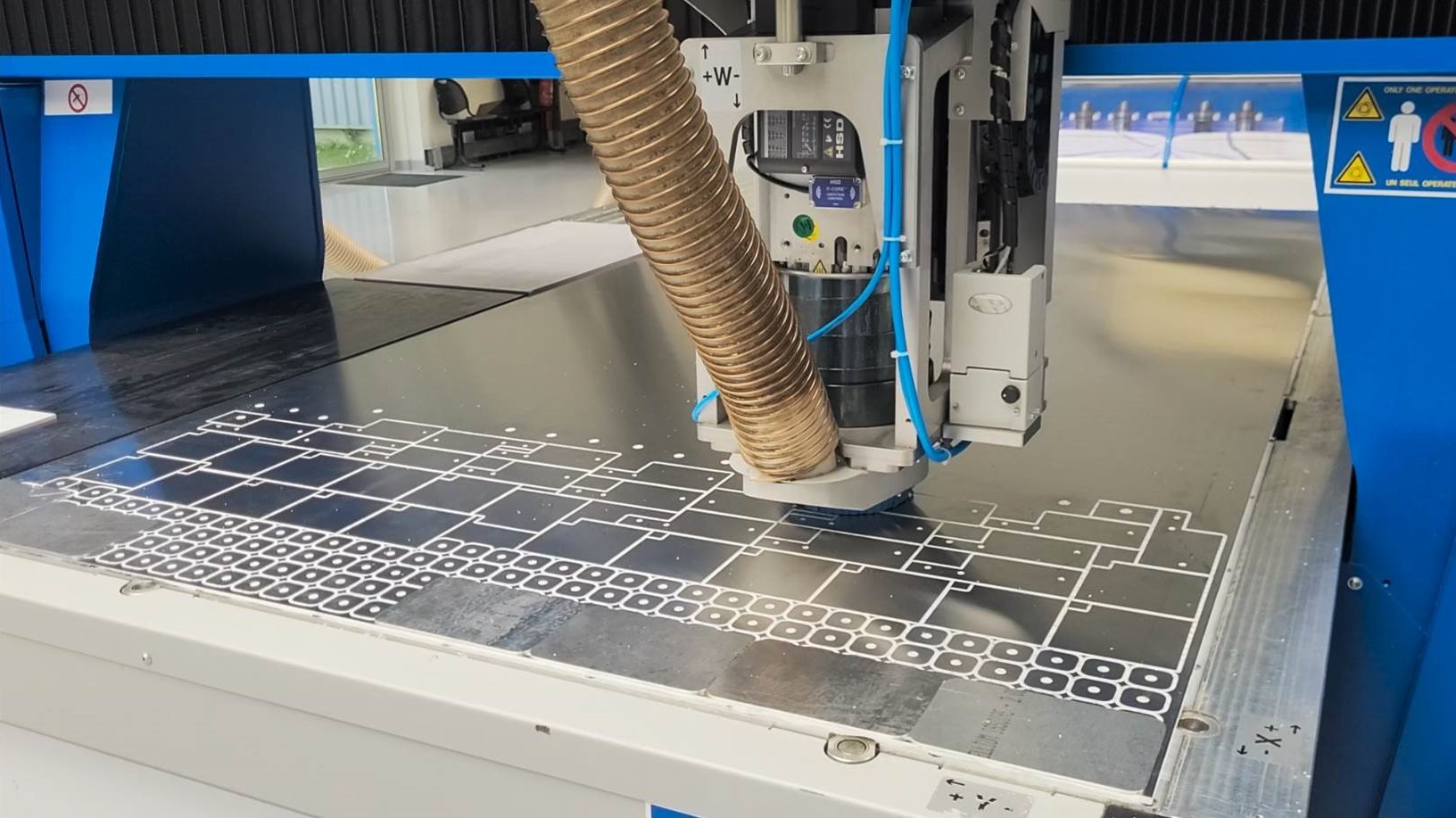
- Non-through shapes: For creating countersinks, pockets or grooves that do not pass through the workpiece.
- Ultra-precision: If a part requires a tolerance of less than a tenth of a millimetre (H7, etc.), finish milling is essential.
Copyright Mécanuméric Industrie - Non-through shapes: For creating countersinks, pockets or grooves that do not pass through the workpiece.
Conclusion: complementary machines
For a company operating in sectors with stringent constraints, the conclusion is clear: primary waterjet cutting offers significant benefits. The gains in profitability are threefold:
- Material: 20% savings in sheet metal thanks to shared cutting and nesting.
- Programming time: unrivalled speed of production start-up.
- Quality: no thermal distortion of the material.
Milling must be repositioned as a reworking operation for complex finishes. By adopting this ‘hybrid’ strategy, workshops maximise their overall OEE (Overall Equipment Effectiveness) whilst drastically reducing their environmental footprint through waste reduction.
Contenu


