


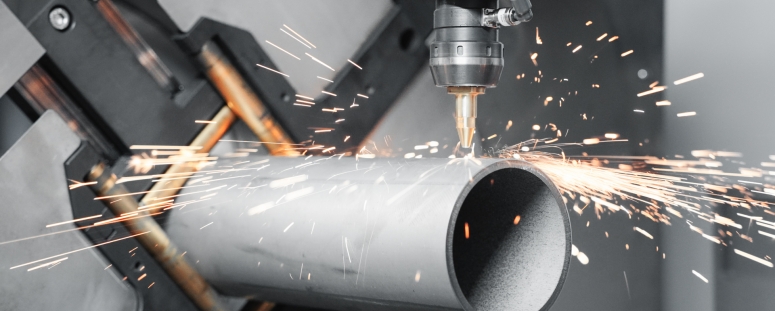
 The market for tube laser cutting is undergoing significant change. Suppliers of flatbed lasers are expanding their expertise and want to secure market share in this sector. The expansion from flat sheet laser cutting to tubes and profiles is a natural development for companies that are already known for their expertise in sheet metal processing, such as Bystronic. This step not only makes sense from a technical standpoint but is also strategically wise. Tubes and profiles offer manufacturers considerable advantages in terms of flexibility and stability and enable optimized production processes in industries such as transportation, construction, furniture, and sporting goods. The market for tube and profile cutting is expected to grow faster than conventional flat sheet cutting, with annual sales likely to exceed the billion-dollar mark by 2030. The use of tubular materials eliminates numerous work steps such as welding and bending, making the design and production significantly more efficient. Many sheet metal processing companies want to enter this market in order to expand their expertise and secure additional sales volumes.
In a competitive environment dominated by established European and Japanese suppliers of laser cutting machines and aggressive new market entrants from Asia, the focus is not only on price but on providing added value through quality, innovation, and service. This, in turn, plays into the hands of the established sheet metal processing companies.
Tube lasers in industrial applications
Tube laser cutting has established itself as a key technology in numerous industries. Particularly in the automotive industry: chassis sections, seat frames, exhaust systems, and roll cages require maximum precision and lightweight construction, which brings out the advantages of tube lasers to their fullest.
The technology also plays a central role in construction and architecture. Structural tubes, railings, curtain walls, and modular building elements can be manufactured quickly and accurately thanks to tube lasers – a prerequisite for stable and aesthetically pleasing constructions.
The furniture and design industry also benefits greatly. Here, tube lasers enable filigree designs and perfect fits for metal furniture, shopfitting, and decorative structures. The low post-processing effort is an additional advantage.
In agriculture, tube lasers are used to manufacture robust frames for plows, trailers, and irrigation systems. Precise plug connections ensure durable constructions.
The aerospace industry also relies on this technology. Complex tube geometries for lightweight construction and safety-critical components require the highest precision – tolerances of up to ±0.1 mm are standard here.
In addition, the process is in demand in HVAC and sanitary engineering, for example for pipe systems in heating, ventilation, and air conditioning systems as well as water pipes.
The technology offers future potential in other areas as well: Fitness equipment and sports equipment benefit from stable, design-oriented tube constructions. In electrical infrastructure, it facilitates the production of cable trays and housing for power and data lines. Industrial automation also relies on precisely manufactured racks, robot arms, and machine frames. Finally, medical technology opens up new possibilities for the manufacture of complex frames and components with the highest precision.
The customer specifies the solution
Innovation goes far beyond hardware. Software now accounts for at least half of customer perception, which is why substantial investments have been made in intuitive, user-friendly solutions that significantly reduce operator training time. Advanced features such as laser scanning for curved tubes, integrated marking, and fast cutting options increase performance, while automation solutions – including bundle loaders, chain loaders, and intelligent sorting – efficiently handle all kinds of tubes. These capabilities enable even less experienced operators to quickly achieve optimal results and underscore the value of holistic solutions. The immediate focus is on implementation: customers should find the right solutions while product features continue to be optimized.There are several markets with correspondingly strong demand, from North America to EMEA to the APAC countries.
It takes more than just fast cutting
Bystronic's product portfolio reflects this ambition. The company's entry into the tube laser segment began with the acquisition of an Italian tube laser specialist in 2018, but the strategy has evolved significantly since then. Confidence in this ambitious growth strategy is based on a combination of brand strength, innovative power, and unique customer proximity through a network of over thirty sales and service companies worldwide. This infrastructure ensures excellent after-sales support, which is crucial for customer satisfaction and follow-up orders.
Versatility is the be-all and end-all
The Bystronic ByTube Star 130 tube laser system is aimed at manufacturers with high volumes who produce hundreds to thousands of parts every day and is already considered the fastest machine on the market. It serves industries such as furniture, shelving systems, fitness equipment, and automotive components. The ByTube Star 330, which was introduced in April 2025, is aimed at contract manufacturers who need maximum flexibility. It processes tubes with diameters from below 20 millimeters to over 300 millimeters, supports small to medium batch sizes, and integrates functions such as thread cutting and drilling. With over 140 modular configuration options, customers can put together customized solutions from standardized building blocks. The market launch resulted in immediate orders and strong global interest, confirming the success of a development process that was closely linked to regular customer workshops and feedback.
Ideally positioned
Innovation is key. As a Swiss company, we must remain innovative. We must continue to improve our products and develop new features that are truly tailored to our customers. Continuous innovation remains the foundation of this strategy. By constantly improving its products, developing new features, and focusing closely on customer needs, Bystronic is ideally positioned to reshape the tube laser cutting market and ensure long-term success.
Contenu


