


 In many sheet metal departments today, the pattern is the same. Cutting systems never stop, bending is always a step behind, and assembly keeps asking the same question: where are my parts? Lead times shrink, product mix explodes, and everything seems to be urgent at the same time.
Whether you are an OEM with your own sheet metal department or a subcontractor serving many different customers, those sheet metal components are no longer a simple commodity. They are a crucial part of your value: they decide how reliable your lead times are, how competitive your prices can be, how far you can go in terms of product customization, and how much free capacity you can create to add additional work to your production schedule. Around this core, the market has become tougher for everyone: a chronic shortage of skilled labor, and of labor in general, and customers who demand faster deliveries, a wider range of variants and lower prices, often in tiny batches.
In this scenario, squeezing a few more percentage points of OEE (Overall Equipment Effectiveness) out of a single machine is no longer enough. The real efficiency gains are no longer on the machines, but between them. That is where high-level automation becomes a strategic lever rather than a technical option.
The real bottleneck is coordination
If we map a typical sheet metal flow, three environments emerge very clearly: the ERP, the programming office, and the shop floor. The ERP holds orders, delivery promises, raw materials and semi-finished items. Programming juggles CAD/CAM, nesting, and machine constraints, trying to reconcile them with customer priorities. The shop floor turns all this into real parts, shift after shift, dealing with changeovers, handling, small disruptions and countless micro-decisions that never make it into any system.
For years, most investments in automation have focused on faster cutting, smarter bending, more capable handling devices. That has certainly helped, at least at the beginning. But as speed and flexibility grew on the machines, all the complexity that used to be absorbed by generous batch sizes and long lead times migrated upstream and between processes. Programming and handling become the bottleneck. Work-in-progress piles up in front of bending. Assembly spends more time looking for missing parts than actually assembling.
We still see static production lists printed every morning, urgent orders added by hand with a highlighter, operators walking with paper nests in their hands to identify parts, buffers overflowing because no one has time to re-sequence for assembly. Adding yet another robot or an even faster laser cutter can easily amplify the problem. Local productivity increases, but global chaos grows with it.
High-level automation is about flipping this logic. It is about moving from isolated cells of performance to coordinated, system-wide intelligence, where ERP, programming and shop floor work on the same live information and the real constraint is no longer coordination, but how much value you can extract from that shared flow.
From machine automation to system intelligence
We can think of high-level automation as three layers working together, rather than three separate projects.
- The first layer is a digital backbone from ERP to finished part. Instead of a static paper job list, the factory works on a live, digital production list that moves from ERP to programming to the shop floor and back again, part by part. Orders are broken down into parts, routes and priorities. Programming systems receive that list, group by material and thickness, and generate machine programs, automatically or semi-automatically. Priorities can be changed in real time, and as each part is produced, status is fed back automatically to the management system. This does more than remove keystrokes. It eliminates entire categories of low-value work and waiting time, and it gives everyone, from planners to operators, one single version of the truth.
- The second layer is multi-level automation, not just faster machines. In a modern sheet metal ecosystem, automation acts simultaneously on process, handling and flow. Processes like cutting, punching and forming are increasingly fed by automatic storage systems that keep a broad range of materials virtually always available, with sharply reduced waiting times between one job and the next. Handling is supported by increasingly fast sorting devices that simplify part separation, by AMRs (Autonomous Mobile Robot) that transfer parts to intermediate buffers or other workstations, and by robots that take over low-value handling tasks, so that systems are never waiting for sheet metal and assembly is never waiting for parts. Above this, software decides how to run production, depending on the current mix and bottlenecks rather than on a fixed layout or flow. When these levels are connected, the sorting logic at cutting knows which kit, order or downstream workstation each part belongs to, and the control system can switch from maximizing material utilization to maximizing kit completeness for assembly, depending on the shift and on the day.
- The third layer is AI in a low-skill, high-mix world. The skills shortage is structural. Designing factories that only very experienced operators can run is no longer sustainable. AI is becoming an enabling technology: it recognizes parts and stacks without pre-determined references, guide robots in picking from messy pallets, monitor critical components, detect issues before they stop a shift and even suggest how to recover sheet leftovers when an urgent job appears. AI does not remove expertise; it codifies it and make high-level performance repeatable, even when experienced staff is scarce.
- The first layer is a digital backbone from ERP to finished part. Instead of a static paper job list, the factory works on a live, digital production list that moves from ERP to programming to the shop floor and back again, part by part. Orders are broken down into parts, routes and priorities. Programming systems receive that list, group by material and thickness, and generate machine programs, automatically or semi-automatically. Priorities can be changed in real time, and as each part is produced, status is fed back automatically to the management system. This does more than remove keystrokes. It eliminates entire categories of low-value work and waiting time, and it gives everyone, from planners to operators, one single version of the truth.
What this already looks like in practice
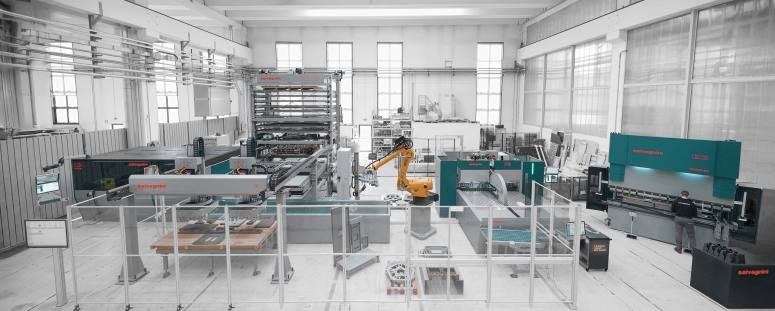
These concepts are not just theoretical. In many European sheet metal plants, both OEMs and subcontractors are already running production with a single digital list that starts in ERP and ends on the packing bench. Cutting, punching, bending and panel bending systems share the same production queue, updated in real time, and line controllers orchestrate automatic warehouses, sorting devices and assembly buffers to keep kits together and bottlenecks under control.
In some layouts, AI-guided robots pick mixed parts directly from transfers coming out of cutting, identify each geometry automatically and feed downstream processes without rigid stacking patterns or job lists. In others, software continuously balance flow between machines, choose where to send each part and when to release new work, so that high-speed cutting does not drown bending in excess WIP and assembly receives complete kits instead of random piles of loose parts.
Whether the customer is making complex products in batch-ones or standard products in large series, these integrated projects show that high-level automation is not reserved for a few showcase factories. It can be scaled and adapted to different sizes and business models, as long as the logic behind it is consistent: connect information, orchestrate flow, reduce human burden where it adds no value, and elevate human contribution where it matters most.
People at the center of automation
There is a persistent fear that automation will make people redundant. In practice, high-level automation tends to do the opposite, especially in high-mix, low-volume environments, whether we are talking about OEMs or subcontractors.
When low-value activities such as loading, unloading, part identification and handling, and manual data entry are automated, experienced personnel can focus on stabilizing processes, improving product design for manufacturability, training new hires and driving continuous improvement instead of saving each shift. At the same time, intuitive HMIs, visual programming and guided workflows lower the entry barrier for new operators, who can reach autonomy in weeks rather than years. In a labor market where every skilled technician is a scarce asset, this becomes one of the main sources of competitiveness, regardless of company size.
From efficiency project to strategic partnership
In the end, high-level automation is not about turning the factory into a dark, empty box. It is about building an ecosystem where orders, machines, automation devices, robots and people share the same information, in real time, and act on it coherently.
In such an ecosystem, efficiency stops being a heroic achievement delivered by a few experts and becomes a natural consequence of how the system is designed. Waiting times are reduced, not just cycle times. Quoting and promise dates are based on real data, not optimistic assumptions. And your factories become more resilient: capable of handling volatility in demand, labor and supply without losing control of lead times and margins.
That transformation is technological, but it is also relational. It requires partners who understand sheet metal not only machine by machine, but as an integrated flow; partners who can bring concrete project experience, listen to your constraints and grow the solution with you over time.
So the real question is no longer: how fast is each machine?
The real question is: how smart and experienced is the partner you have chosen to support you in this transition, and how well can you work together to make that intelligence serve your factory, every day?
Contenu


