


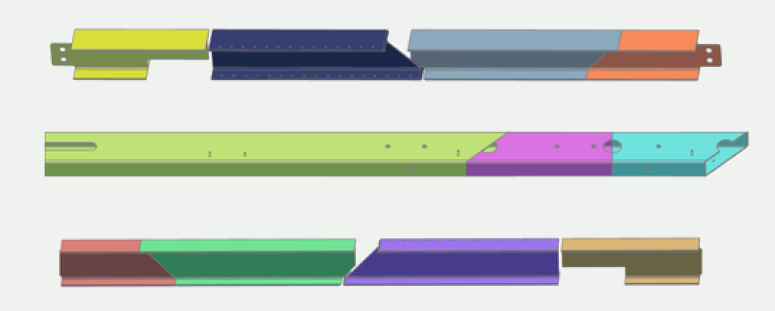
Article written by Estelle CHARASSON, Application Engineer Almacam Tube and
Simon CHANAL, Optimization Software Engineer Almacam
Efficient tube nesting involves complex optimization challenges. We asked the engineers who develop Almacam’s nesting algorithms to explain what really determines the quality of a nesting result and, using real examples, what makes one nesting technology more efficient than another.What is tube nesting?
Tube nesting consists in finding the best way to arrange different parts along a tube or profile before cutting. However, it would be simplistic to assume that the layout using the least material is always the best possible optimization.
Efficient tube nesting is a multi-criteria optimization problem involving many parameters. The objective is not only to minimize material consumption, but to optimize the overall production cost, taking into account material costs, cutting costs, processing time, and various industrial constraints.
Why is tube nesting so important in production?
In tube and profile cutting, nesting has a direct impact on the amount of material required to produce a batch of parts. For large production volumes, a difference of just a few percentage points between two CAM solutions can represent a significant amount of material. The objective is therefore to produce the required parts using as little material as possible, while making effective use of available remnants.
What is the difference between standard tube nesting and optimized nesting?
Producing a valid nesting result is becoming increasingly accessible. However, gaining the last few percentage points of material efficiency in complex industrial cases, with multiple constraints, remains a high-level algorithmic challenge. Moving, for example, from 90 to 95% material utilization, or even from 95 to 96%, requires much more advanced optimization strategies.
Yet, these few percentage points can have a significant economic value. Every percentage point of material saved directly reduces the material cost of production. When material accounts for a large share of production costs, reducing material costs by just 1% can result in an increase in margin of around 10%.
Let’s take an example with 130 tubes to be nested (26 green, 52 pink and 52 blue) on 6-meter bars. An efficient nesting solution can place all the parts on 26 bars, with a single layout. A less optimized solution requires 27 bars and 7 different layouts.
Optimized nesting (26 bars, 1 layout) 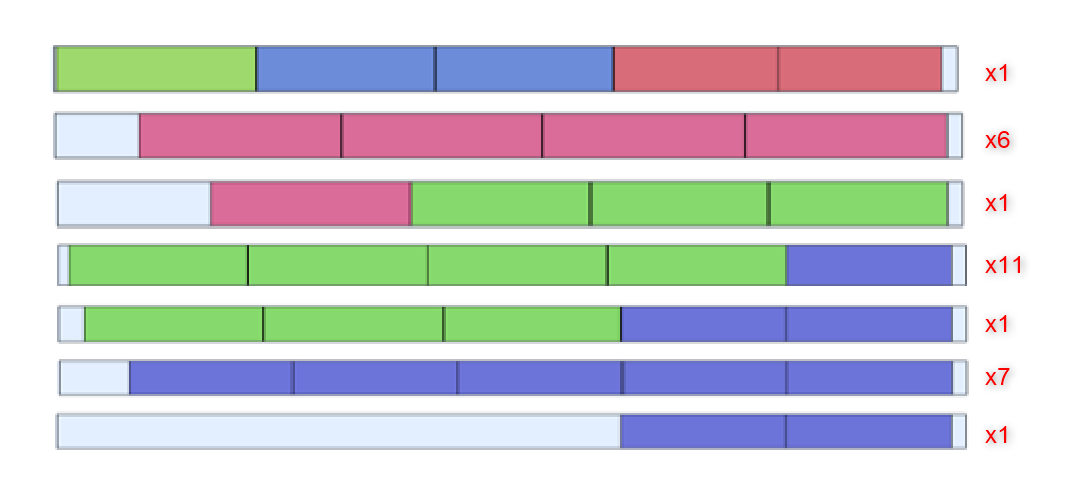
Poor nesting (27 bars, 7 layouts)
The first solution therefore saves material, but also programming time. To find it, the algorithm needs to explore a very large number of possible combinations efficiently.
The gap can widen even further when the nesting process has to account for real production constraints, such as priorities between parts, common cuts or remnant management.
These use cases show that two nesting results may appear equally efficient at first sight. However, the way constraints are handled within the algorithms can lead to different results. Precise rather than approximate constraint management can make a significant difference in material utilization. This is where the quality and sophistication of nesting algorithms become critical, and where a tube cutting software with advanced nesting makes the difference.
Many CAD/CAM solutions offer automatic tube nesting. What really differentiates them?
When comparing tube nesting solutions, two – or even three – aspects should be considered.
1. The ability to handle real industrial production cases
Before comparing optimization performance, you first need to check whether the software provides you with the features required to handle real production situations: different tube and profile geometries, machine-specific characteristics, cutting processes and workshop-specific constraints.
Some of these features are complex to implement. They require the optimization algorithms to be intelligently adapted to the industrial requirements involved. A software solution may appear to perform well on basic cases, but deliver disappointing results when faced with real production situations.
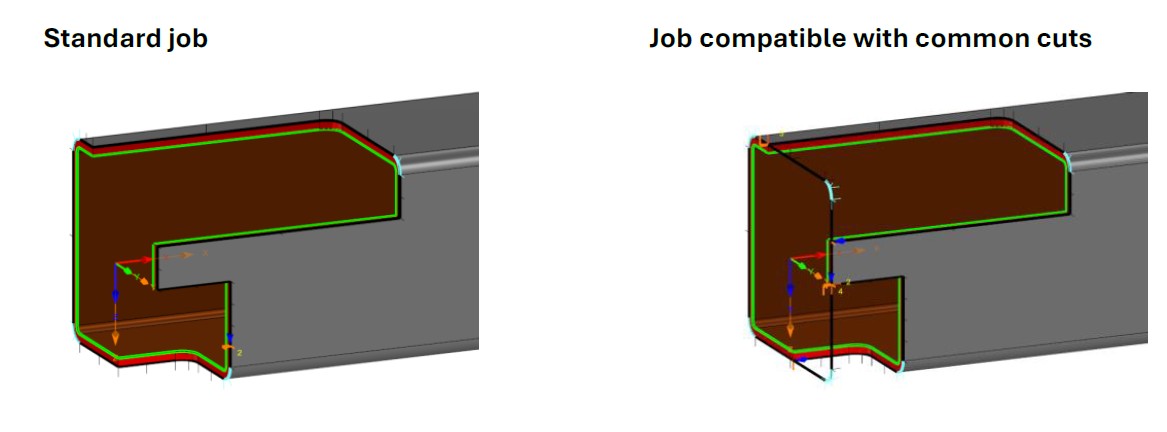
Take profile nesting as an example. To simplify the calculation, an algorithm could represent each part only by its bounding box – the rectangle surrounding it. This approximation makes nesting easier, but does not take the actual geometry of the end cuts into account. Two parts that could be positioned closer together thanks to the shape of their ends would then be considered larger than they really are, resulting in poorer material utilization.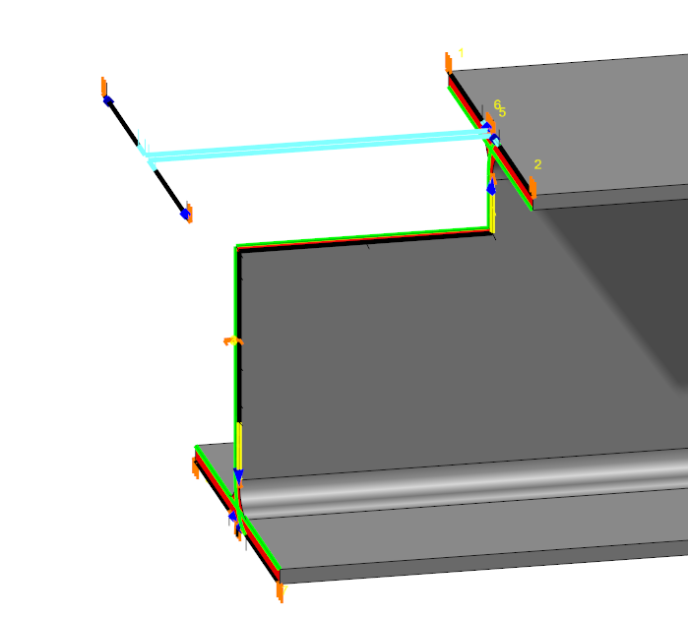 Example: to cut the following profile while respecting its geometry, material needs to be removed from the flanges by adding “rectangle cuts”. This makes it possible to perform the cut without collisions.
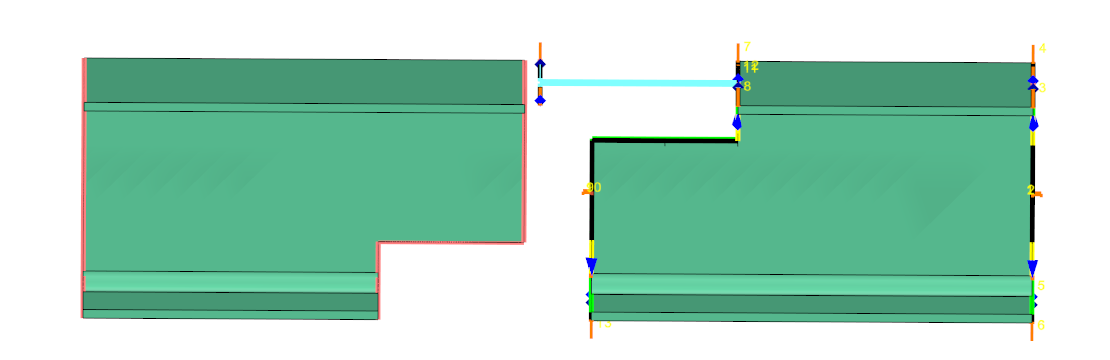
An optimized nesting of two occurrences of this part will take into account all the cuts required to produce the profile, rather than relying only on their bounding boxes.
2. The performance of the nesting itself
Once this first condition is met, the difference lies in the software’s ability to optimize not only material utilization, but also cutting and preparation times. Again, this performance needs to be evaluated using real cases, taking into account the actual processes and constraints of the workshop. After all, an excellent optimization result has little value if it cannot actually be applied in production.
There is also a third criterion to consider alongside these two technical aspects: the overall quality of the CAD/CAM software and its support.
A high-performance algorithm only delivers real value when it is integrated into reliable and efficient software for everyday use. Ease of use, stability, robustness and reliable results are therefore essential. Otherwise, the gains achieved through optimization can quickly be lost elsewhere in production. The responsiveness and expertise of the support teams also matter, especially when complex production issues need to be resolved quickly.
With AI making software development easier, why does tube nesting still require advanced algorithmic expertise?
As AI becomes more widely used in software development, it is getting easier to create tools capable of solving relatively standard optimization problems. But generating code does not mean mastering a complex optimization problem in an industrial environment.
In tube nesting, the real challenge is not simply to find a possible layout for the parts. It is to achieve the best possible material efficiency while respecting all the industrial constraints that actually affect production: part and profile geometry, permitted orientations, cutting constraints, reusable remnants and machine-specific requirements. These factors can considerably increase the complexity of the problem.
Take priorities between parts as an example. If parts A (purple) have priority over parts B (green), and the stock of bars is limited, a simple approach would be to place as many A parts as possible first and then use the remaining space for B parts. The priorities are respected, but the A parts are positioned without taking the B parts into account.
As a result, the algorithm may miss a better solution – for example, alternating A and B parts to take advantage of common cuts.

A more advanced approach integrates priorities directly into the optimization. It considers A and B parts simultaneously to optimize their placement, while ensuring that B parts areonly placed if all A parts can be nested. Priorities are respected without sacrificing the overall nesting performance.
How can remnants be managed and reused in tube nesting?
Remnant management also plays an important role in optimization. An efficient nesting algorithm needs to be able to assign a value to the available remnants, but also to the remnants that would be generated by each nesting solution. It can then automatically decide whether it makes more sense to use an existing remnant or a new bar.
This approach saves material, makes effective use of available remnants, and helps prevent them from accumulating in the workshop.
In this specific use case, the objective is to cut 75 identical parts. New bars of 6 m and 4.5 m are available, along with two remnants measuring 3.22 m and 3.65 m.Problem
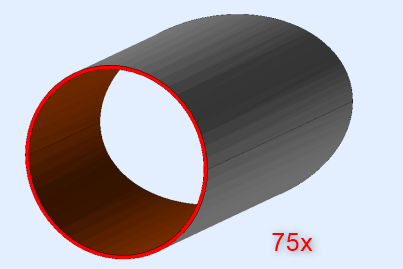
o Bar: 6000 mm
o Bar: 4500 mm
o Remnant: 3220 mm
o Remnant: 3650 mmThe challenge is choosing the right combination of bars. In this example, the best solution uses only three: one existing remnant, one 6 m bar and one 4.5 m bar. This combination produces all the required parts while generating almost no new remnant.
Solution
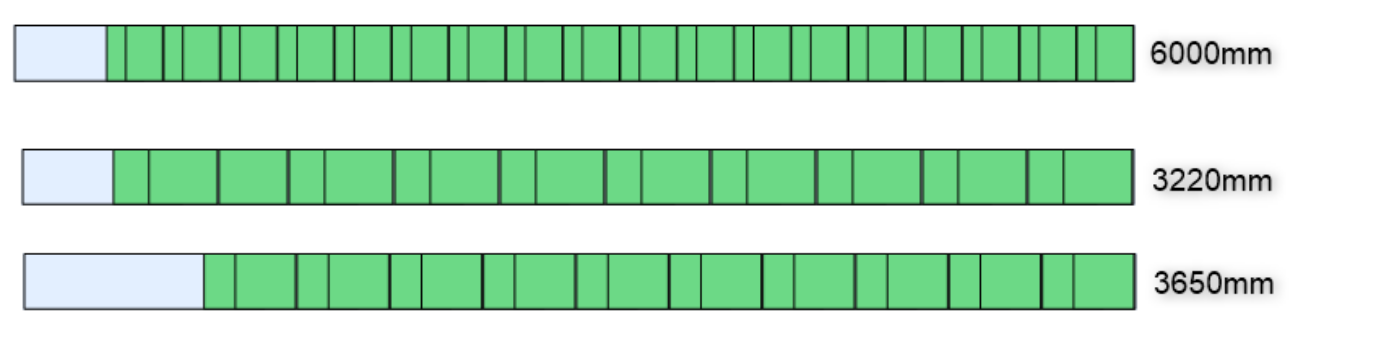
The other combinations require four bars. They would increase production time, and generate more remnants that would then need to be managed and stored in the workshop.
The same principle should be applied more generally: available remnants need to be taken into account by the nesting algorithm and reused in future nesting layouts.
When can common cuts be used, and what are their advantages?
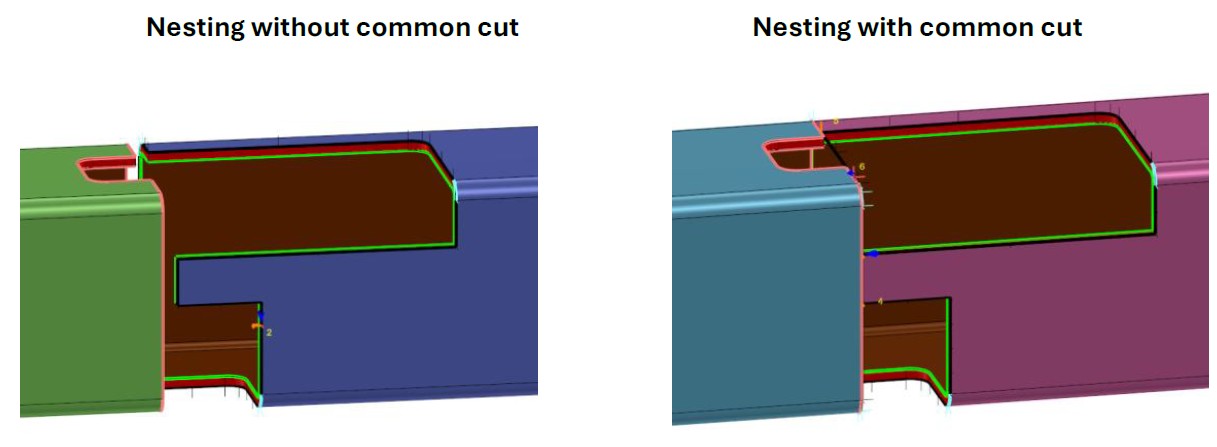
A common cut in a nesting uses the same cut to separate two adjacent parts nested in a tube. This can:
• reduce material consumption by eliminating the space that would otherwise be required between the two parts
• reduce cutting time, since one cut replaces two separate operations
• reduce certain movements or repositioning operations of the cutting head
However, common cuts cannot be used with every geometry or cutting process. The nesting algorithm therefore needs to determine when a common cut is technically feasible and beneficial.
For tubes with notches or protrusions at their ends, detecting common cuts becomes even more difficult. In these cases, nesting algorithms need to be able to modify the cutting paths and create common cuts even when the two ends share only part of the cutting path. This is known as a partial common cut.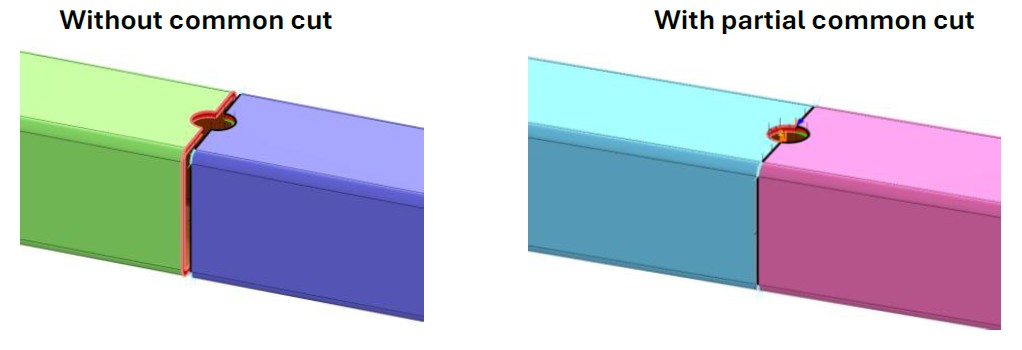
Even when tubes have complex end cuts, an advanced nesting algorithm can take them into account to automatically identify and generate common cuts whenever possible.
Why can two tube nesting software solutions produce different results from exactly the same parts?arts?
Each software solution explores a portion of the possible solutions, depending on the performance of its algorithms, and then selects the best solution it has found. So, naturally, two software solutions can produce different layouts.
They may also evaluate those solutions using different criteria: material utilization, cutting time, production constraints, and so on. Even if they identify broadly similar nesting layouts, they will not necessarily select the same one as the best solution.
An advanced algorithm explores options in greater depth and more efficiently, increasing its chances of identifying a more optimized solution.
Let’s look at another practical case to understand what can distinguish a truly high-performance tube nesting technology.
Two-chuck tube cutting machines have a major limitation: on each bar, approximately the last 200 millimeters are inaccessible to the machine – as illustrated by the area outlined in red below. In theory, this creates an unavoidable remnant.
A standard nesting algorithm will apply this machine limitation strictly, and will not place any part in the inaccessible area. On the bar shown below, it would therefore only be possible to place three green parts.
With a detailed understanding of the machine’s capabilities and of this inaccessible area, the constraint can be handled differently, making it possible to place parts within this zone. To do so, there must be no cut inside the inaccessible area. This means that the final cut of the part does not need to be performed: instead, the end of the part is aligned with the end of the bar.

Contenu


